
 Skip to content
 Marble has been the material of choice for architects, designers, and homeowners for centuries — and not without reason. It combines a natural beauty that no manufactured material can replicate with a durability that, when properly maintained, outlasts virtually everything else you could put on a floor or wall. Yet for all its prestige, marble remains one of the most misunderstood materials in home design. Walk into any tile showroom and you will find dozens of options, finishes, and price points — with very little guidance on what actually matters.
This guide cuts through the noise. Whether you are renovating a bathroom, specifying a kitchen worktop, or planning a full-scale interior project, here is everything you need to know to choose the right marble for every room — with a focus on the varieties, formats, and finishes that work best in UK and US homes.
The resurgence of natural stone in contemporary interiors is not a trend — it is a return to first principles. After decades in which synthetic materials dominated the market on the basis of cost and convenience, designers and homeowners alike are rediscovering what architects have always known: no manufactured surface matches the depth, warmth, and visual complexity of natural marble. Each slab is unique, formed over millions of years and impossible to replicate precisely — which is precisely the point.
Porcelain printed to look like Carrara has improved dramatically, and at a distance, some products are genuinely convincing. But under natural light, at close range, or when used at scale across a large floor or feature wall, the difference becomes apparent. Natural marble has translucency — light penetrates the surface and reflects back through the stone, creating a luminosity that printed porcelain cannot achieve. It is also three-dimensional: polished marble reflects light differently at every angle, responding to how a room changes throughout the day.
From a practical standpoint, natural marble performs well in every area where it is traditionally used. Properly sealed and maintained, a marble floor can outlast the building around it. Roman bath complexes, centuries-old churches, and Victorian railway stations all testify to marble’s longevity. The maintenance requirements that put some homeowners off are real but manageable — and significantly overstated in the popular perception.
The question is never really whether to choose marble — it is which marble, in which finish, for which application. Getting those three variables right is what separates a successful natural stone project from one that disappoints. The sections that follow address each variable in detail.
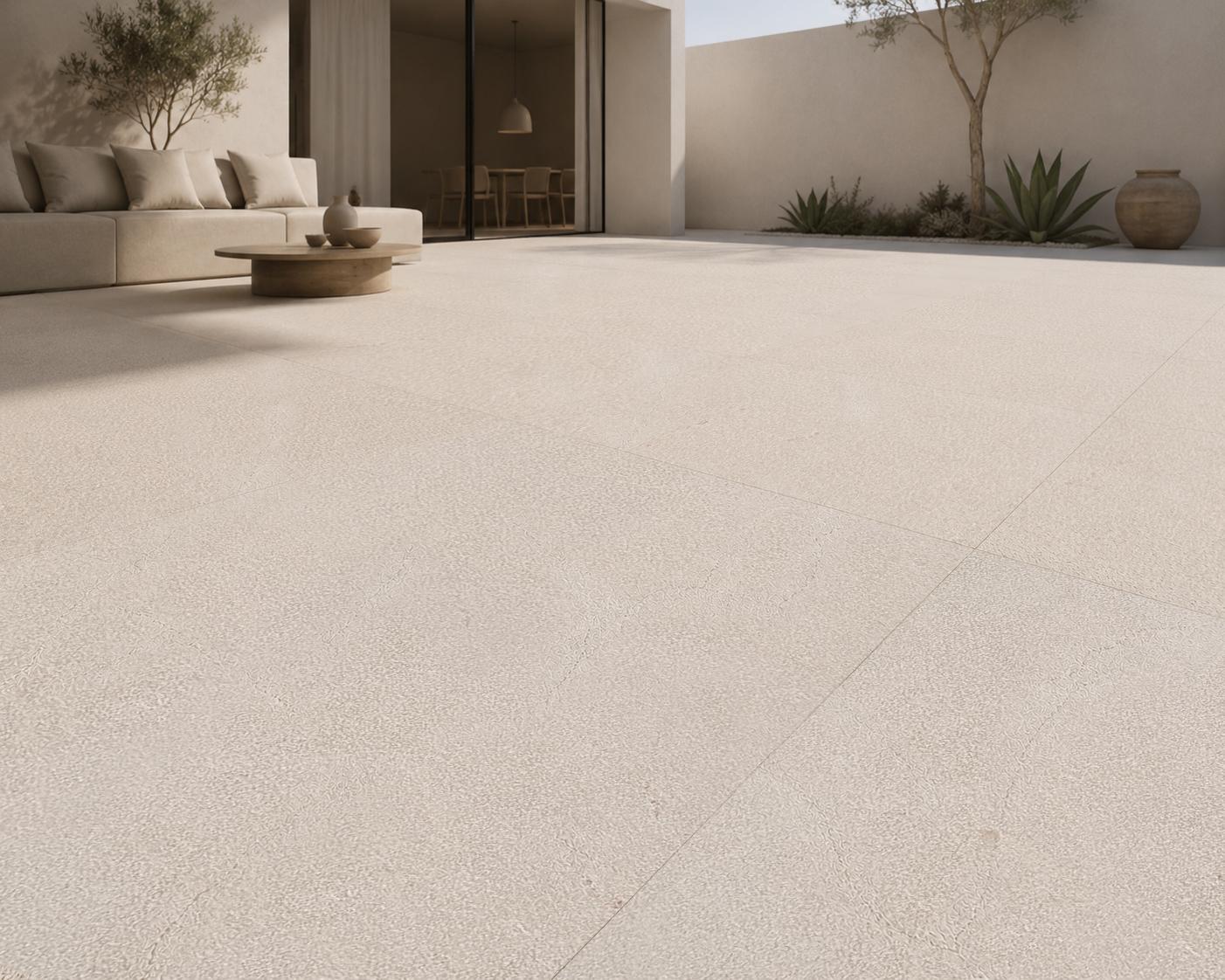
Before diving into room-by-room guidance, it helps to understand the two properties that most directly affect how a marble will perform and look in a given space: colour and veining, and hardness and porosity. These are not purely aesthetic considerations — they have direct implications for where each variety can be used and how it needs to be maintained.
Marble colour ranges from pure white (Bianco Carrara, Statuario) through creams and beiges (Crema Marfil, Botticino) to greys (Bardiglio, Pietra Grey) and dramatic blacks (Negro Marquina, Marquina Black). Veining — the network of mineral deposits that runs through the stone — varies from fine and barely visible to bold and graphic. White marbles with strong grey veining, such as Calacatta, have become synonymous with luxury interiors; cream marbles like Crema Marfil, with their subtle, diffuse patterning, offer a more restrained elegance.
For large floors or feature walls, the visual rhythm of the veining matters as much as the colour. A strongly veined marble like Statuario can feel busy if used across an entire floor at scale; the same material used as a single feature wall behind a bath creates a dramatic focal point without overwhelming the space. Lighter, more uniform marbles are generally safer for large surfaces.
Marble is a metamorphic rock composed primarily of recrystallised calcium carbonate. Its hardness varies between varieties, typically falling between 3 and 4 on the Mohs scale — softer than granite (6–7) but durable enough for most residential applications when properly specified. More practically relevant than hardness is porosity: marble is a porous material that will absorb liquids if left unsealed. In areas exposed to water, oils, or acidic substances — bathrooms, kitchens, dining areas — sealing is not optional.
Denser marbles such as Negro Marquina and Tundra Grey are less porous than white varieties and require less frequent resealing. Crema Marfil sits in the middle range. Carrara — the most widely used marble in residential applications — requires conscientious sealing in wet areas but rewards that care with a longevity unmatched by any synthetic alternative.
The hallway is the most common starting point for marble flooring in UK and US homes — and one of the most rewarding applications. A well-specified marble entrance floor sets the tone for the entire property and adds lasting value. In a hallway, the priority is a marble that reads as coherent across a relatively large surface: Crema Marfil and Botticino work exceptionally well here, their warm beige tones creating a welcoming effect without visual complexity. Grey marble varieties such as Bardiglio or Pietra Grey suit more contemporary settings and pair well with brushed steel and pale timber.
For living rooms, the choice depends on whether the marble is intended as a statement or a background. An open-plan living space in a modern home might use a large-format Pietra Grey tile in a honed finish — cool, calm, and almost architectural in character. A more traditional interior might use a Classic Crema Marfil in a polished finish with a contrasting border detail. Budget for good-quality marble flooring in these applications typically starts at £50–55/m² for the stone itself, before installation.
The bathroom is where marble genuinely excels. The combination of natural light, water, and reflective surfaces creates the ideal setting for polished marble — and the relative scale of most bathrooms means that even strongly veined varieties can be used without overwhelming the space. The classic specification is Carrara white in a polished finish on the floor and walls, with large-format tiles and minimal grout joints. This remains a safe and timeless choice for a reason: it works in almost every context, from period townhouses to contemporary apartments.
Honed finishes deserve consideration in bathrooms, particularly for shower floors where slip resistance matters. A honed Carrara or Crema Marfil floor has a soft, matte quality that photographs beautifully and feels warm underfoot. The trade-off is that honed marble shows watermarks and soap residue more readily than polished, requiring more frequent wiping down in heavy-use bathrooms.
For those wanting a bolder statement, Negro Marquina is the natural choice. Its deep black ground with white veining creates a high-contrast, hotel-like aesthetic that has become one of the signature looks of high-end bathroom design. Used floor-to-ceiling in a wet room or as a feature wall behind a freestanding bath, it transforms a functional room into something genuinely architectural.
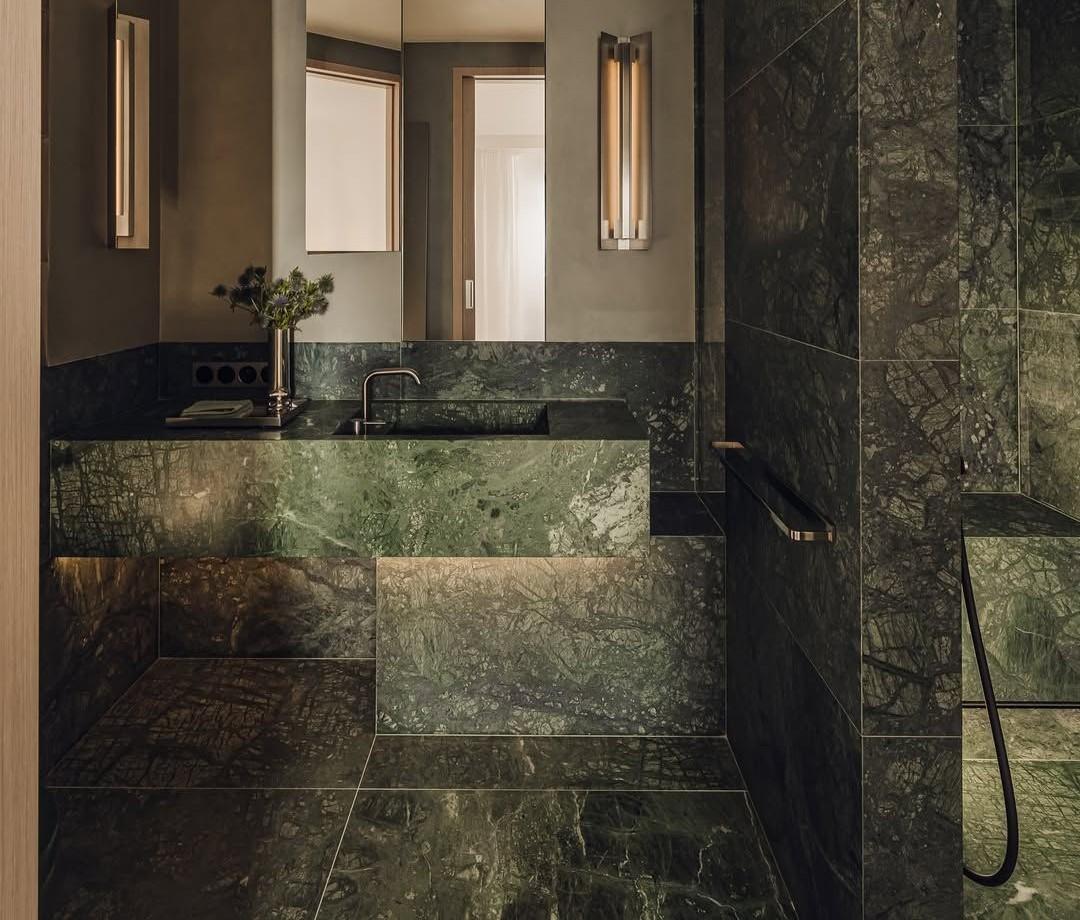
Marble kitchen worktops require a different specification mindset to floors. The worktop surface is in constant contact with food, liquids, and cleaning products — all potential sources of staining or etching. The standard thickness for a kitchen worktop is 3 cm, which provides sufficient weight and rigidity for unsupported runs. Thinner profiles (2 cm) are used for waterfall edges and other decorative applications but should be supported across their full length.
For kitchen worktops, a honed finish is generally preferred over polished. Polished marble etches visibly when it comes into contact with acidic substances — citrus juice, wine, tomato — leaving dull patches in the surface. Honed marble etches too, but the marks are far less visible against the matte ground. Many homeowners actively prefer the patina that develops on a honed marble worktop over time, viewing it as evidence of a material that lives and ages naturally.
Variety selection for kitchen worktops should favour denser, less porous marbles. Crema Marfil and Bianco Marmara are both excellent choices, offering warmth and elegance with relatively good resistance to staining when properly sealed. For those wanting the drama of full-slab Carrara across an island or run of worktops, it remains achievable with the right sealing regime — but requires a client who understands and accepts the maintenance commitment.
Wall applications open up different possibilities to floors, primarily because weight and slip resistance are no longer constraints. Marble wall tiles can be specified in thinner profiles (typically 10–12 mm) and in larger formats, which dramatically reduces grout joint frequency and creates a cleaner, more seamless aesthetic. For shower enclosures, large-format wall tiles in a continuous run — floor to ceiling, wall to wall — eliminate the visual clutter of small tiles and create the impression of stepping into a solid marble room.
Book-matching is one of the most effective techniques available when working with marble wall tiles. Two adjacent slabs cut from the same block and opened like a book produce a symmetrical, mirror-image veining pattern. Used across a feature wall or as the back panel of a shower enclosure, a book-matched pair of Calacatta or Statuario slabs becomes a piece of natural art — no two installations can ever be identical. This technique requires sourcing matched pairs from a supplier with the relevant inventory, and adds cost, but the visual impact is difficult to achieve by any other means.
For more practical, repeating applications — tiled bathroom walls, shower enclosures specified from standard stock — 30×60 cm and 60×120 cm formats work well with most marble varieties and are widely available. The larger format reduces grout joints and makes cleaning easier; the smaller format is more forgiving on walls that are not perfectly flat.
Getting the specification right requires attention to four key points, regardless of the variety or application:
Pulycort supplies natural marble direct from quarry to project — no intermediary markups, full traceability from extraction to delivery, and direct access to slab selection at source. Our portfolio covers all the varieties referenced in this guide: Carrara, Crema Marfil, Negro Marquina, Tundra Grey, and Pietra Grey, alongside a wider range of natural stones suited to both residential and commercial applications.
We supply to architects, interior designers, developers, and homeowners across more than 60 countries. Whether your project requires a standard floor tile specification or a bespoke full-slab book-matched feature wall, our team can advise on variety selection, finish, format, and logistics from the first enquiry.
Browse our marble collection or get in touch to discuss your project with a specialist.