

Choosing the right size of marble slab is a decision that shapes the look, the installation cost and the durability of the finished work. There is no universally best size — there is the most suitable size for each project, and finding it means understanding which variables come into play before you place your order.
In this article we explain the sizes available on the market, their technical characteristics, their most suitable applications and the criteria that should guide your choice depending on the type of project.
What marble slabs are and what they are used for
A marble slab is a piece of natural stone cut to a specific rectangular or square size, with a set thickness and a surface finish applied. It is the basic working unit in most natural marble cladding projects.
It is used across virtually every area of architecture and interior design: home floors, bathrooms, kitchens, stairs, wall cladding, countertops, facades and outdoor areas. Choosing the right size is not just an aesthetic matter — it directly affects how easy the installation is, how much material is wasted in cutting, the weight the structure has to bear and the final visual result of the space.
The trend in recent years has been towards ever larger sizes, especially in high-quality residential projects and commercial interior design, where fewer joints and visual continuity are top priorities. Even so, medium and small sizes still have specific applications where they offer real advantages over large pieces.
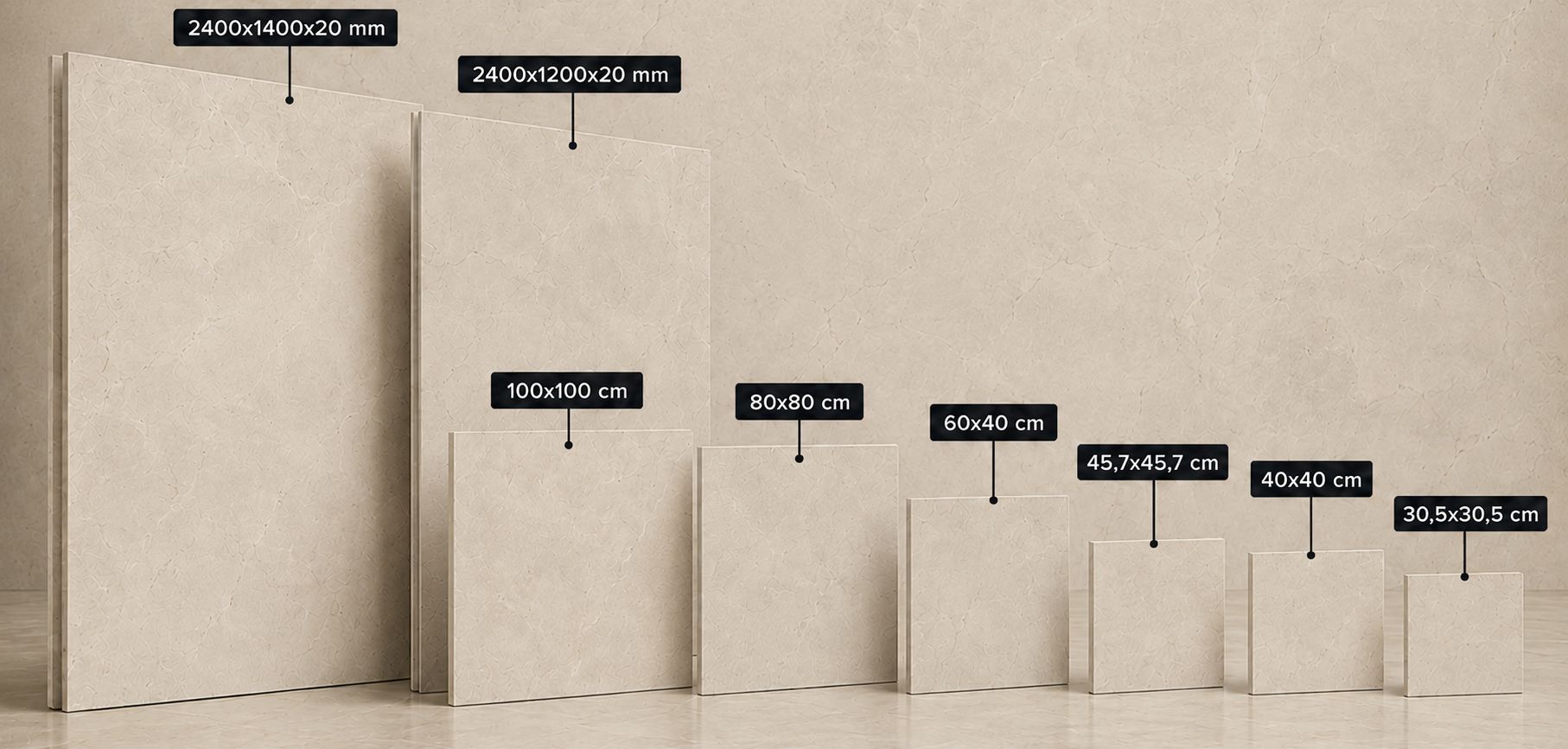
Main marble slab sizes
Large slabs
Large sizes cover pieces from 60×60 cm upwards, the most common being 60×60 cm, 60×90 cm, 60×120 cm and 80×80 cm. They are the dominant sizes in mid-to-high-end residential projects and in commercial spaces where visual continuity is a priority.
Their main advantage is aesthetic: with fewer joints, the floor or wall gains continuity and the veining of the marble can flow from one piece to the next, creating an almost seamless surface. In spaces with good natural light, this effect amplifies the sense of space and makes rooms look larger.
From a technical point of view, large slabs need a perfectly level, flat base. Any irregularity in the substrate shows through on the surface and creates discontinuities between pieces that are hard to correct once installed. For sizes from 60×120 cm upwards, levelling systems are commonly used during laying.
They are the preferred choice for living rooms, large bedrooms, medium to large bathrooms, full-height wall cladding and circulation areas with enough surface for the size to show off.
Medium slabs
Medium sizes — between 30×30 cm and 60×60 cm — are the most versatile in the range. They suit almost any space, simplify transport logistics and make installation easier in rooms with many corners, changes of level or irregular perimeters.
They are the most common choice for standard-sized bathrooms, kitchens, conventionally sized rooms and any area where you want the look of marble without the technical complexity of large sizes. They are also the most widely used in renovation projects where the structural conditions of the substrate do not allow heavier or larger pieces.
In terms of material waste, medium sizes offer an optimal balance: small enough to adapt to spaces with frequent cuts, large enough for the veining of the marble to be appreciated.
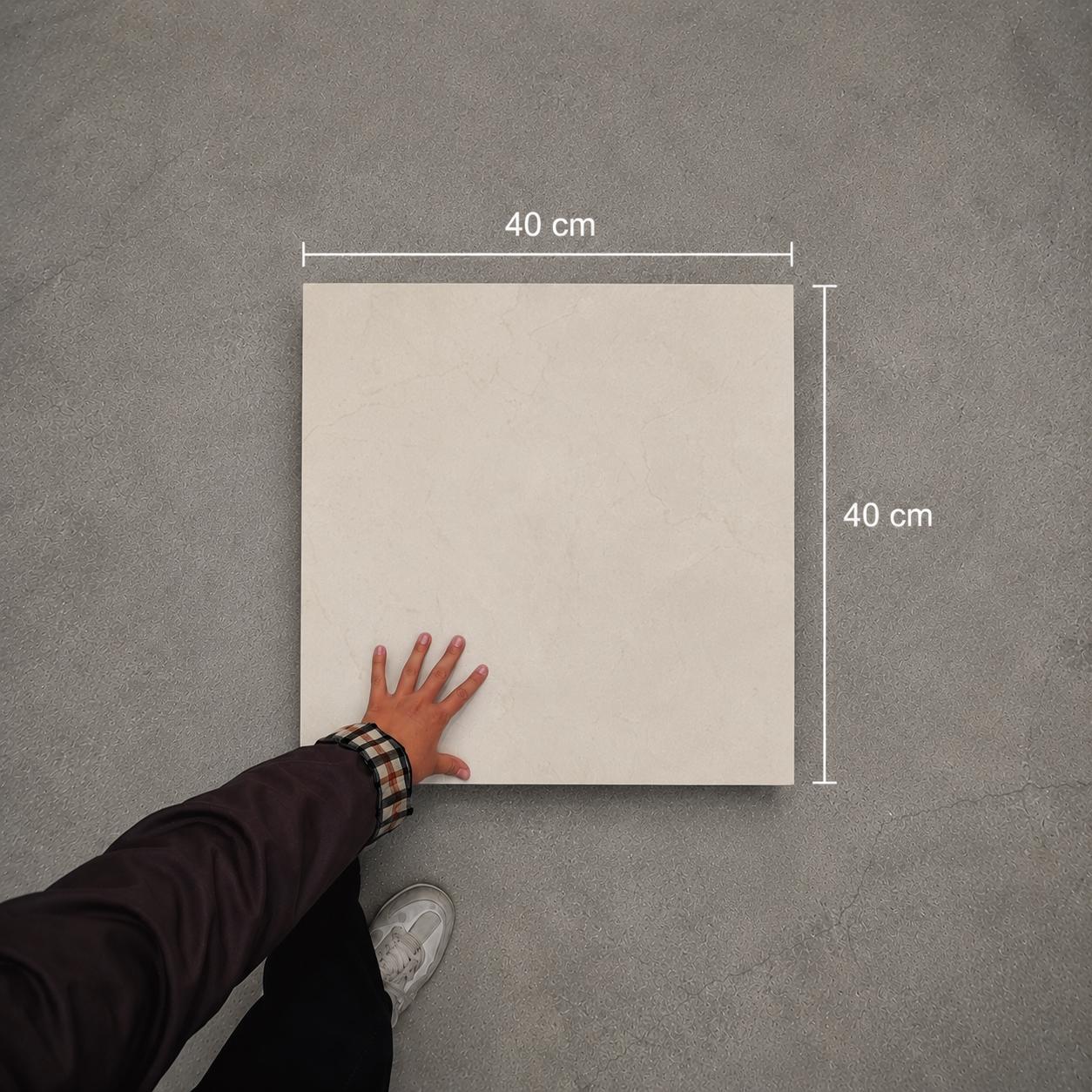
Small slabs
Sizes below 30×30 cm — such as 20×20 cm, 15×30 cm or 10×10 cm — have their own specific applications, where they offer advantages that larger sizes cannot.
They are most often used for cladding showers and wet areas where slip resistance is the priority, in restoration projects for historic spaces where the original sizes were small, on sloping or uneven outdoor paving, and in designs that aim for a specific geometric pattern through the layout of the pieces.
They also appear frequently in highly customised decorative projects — borders, mosaics, geometric compositions — where marble is worked more as an artistic material than as conventional cladding.
Special sizes: jumbo and jumbo plus
Advantages of jumbo slabs
Beyond the standard sizes, there is a category that has gained growing prominence in high-end architecture projects in recent years: jumbo and jumbo plus slabs.
Jumbo slabs are pieces larger than 120×240 cm, and in some cases can reach 150×300 cm or even more, depending on the source block. Their main advantage is a visual effect that no standard size can match: the veining of the marble unfolds along its full natural length, without interruption, creating a surface of extraordinary continuity and presence.
With practically no joints, maintenance is simpler and the sense of cleanliness and spaciousness is multiplied. They are also the most prized pieces for single-piece countertops — especially kitchen islands and bathroom countertops — where the absence of joints is both an aesthetic and a hygienic requirement.
Added value: An installation with jumbo slabs immediately conveys a level of investment and care that conventional sizes cannot match. It is the detail that separates a well-finished bathroom from a truly exceptional one.
Recommended applications for jumbo
Jumbo slabs are designed for spaces where visual impact is the absolute priority: luxury hotel lobbies, showrooms, high-end homes, very large bathrooms and landmark facades of commercial buildings. They are also the solution for kitchen island countertops where the absence of joints is a requirement.
They require specific transport and handling equipment — vacuum lifters, teams of two or more people, support structures during installation — and technical planning with the installer beforehand is essential to guarantee a perfect result.
How to choose the right size for your project
Private homes
In a home, the main criterion is the proportion between the slab size and the floor area of the room. As a general rule:
- Under 12 m²: Medium sizes (40×40 or 40×60 cm) keep the floor from looking cramped.
- Between 12 and 25 m²: Large sizes of 60×60 or 60×90 cm give their best results.
- Over 25 m²: Large and jumbo sizes let you show off the full visual potential of the marble.
Bathrooms work well with medium and small sizes, especially if you use different pieces on the floor and walls to create contrast. Kitchens call for specific decisions on slip-resistant finish and stain resistance before the size is chosen.
Commercial projects
In shops, offices, hotels and public spaces, large or jumbo sizes are the usual choice for three reasons: better resistance to heavy foot traffic, ease of cleaning and maintenance, and a more polished, representative image.
In these projects it is also essential to consider thickness — high-traffic surfaces need thicker pieces to guarantee durability over time.
Facades and large surfaces
Exterior cladding with marble slabs calls for sizes suited to the building’s modular grid and fixing systems appropriate to the type of installation. On ventilated facades, thinner pieces are used with mechanical fixing systems. For bonded cladding on flat surfaces, large sizes work well if the substrate has the right flatness.
In any case, before deciding on the size for a facade project, it is essential to consult the technical supply team to determine the correct thickness, fixing system and the most suitable finish for the exposure conditions.
Available thicknesses and finishes
2 cm, 3 cm and special thicknesses
The standard thickness for interiors is 2 cm — enough for floors and wall cladding in normal domestic use. For exteriors, high-traffic areas or countertops that will bear loads, a thickness of 3 cm offers greater resistance to breakage and bending.
There are also special thicknesses of between 3 and 4 cm for ventilated facades and large-format monolithic countertops where the rigidity of the piece is decisive.
The choice of thickness directly affects the total weight of the paving and the demands placed on the supporting structure. A 2 cm marble floor in a 60×60 cm size weighs approximately 30 kg/m² — a relevant figure in refurbishments of existing buildings where the structure has a limited load capacity.
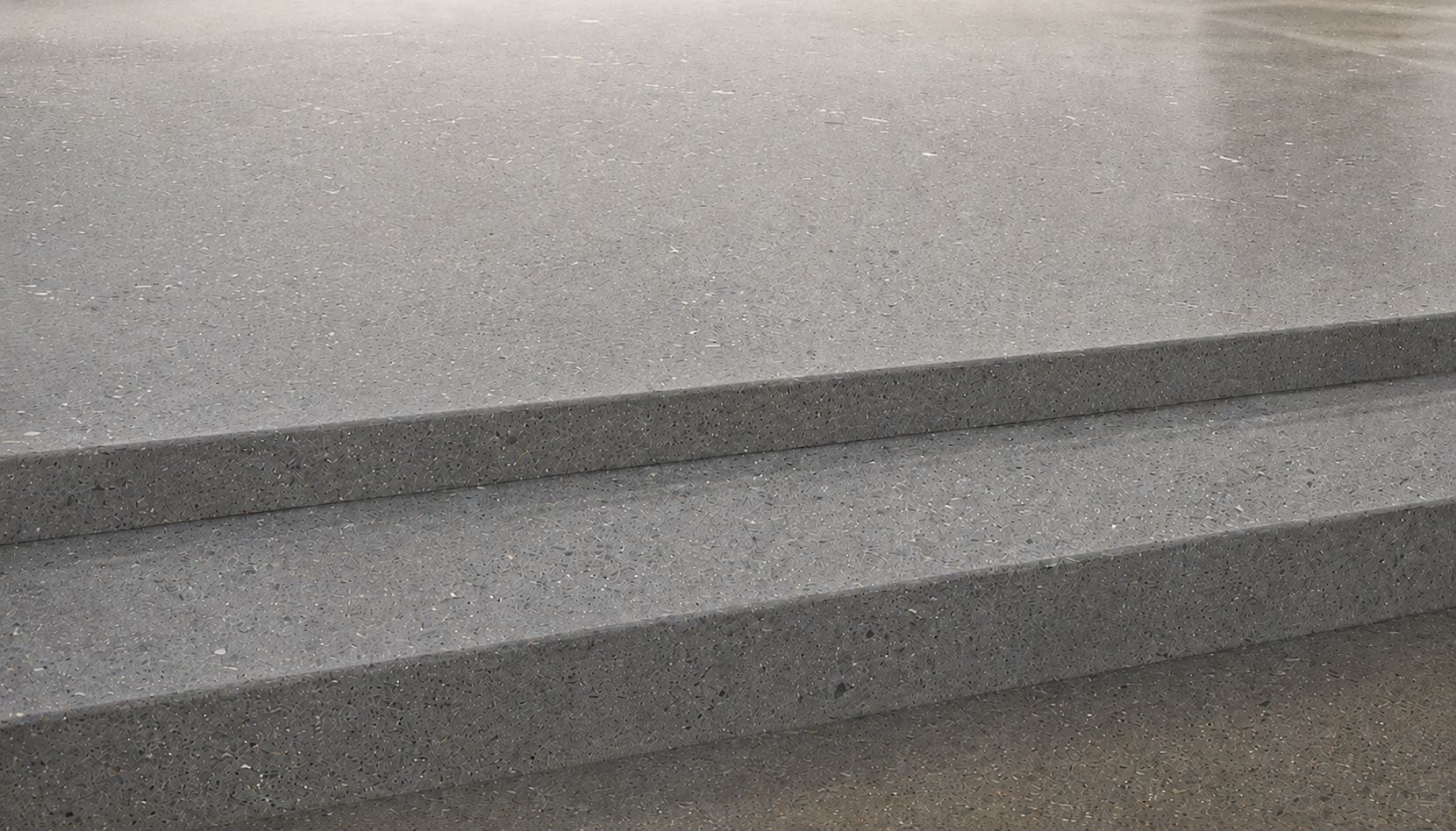
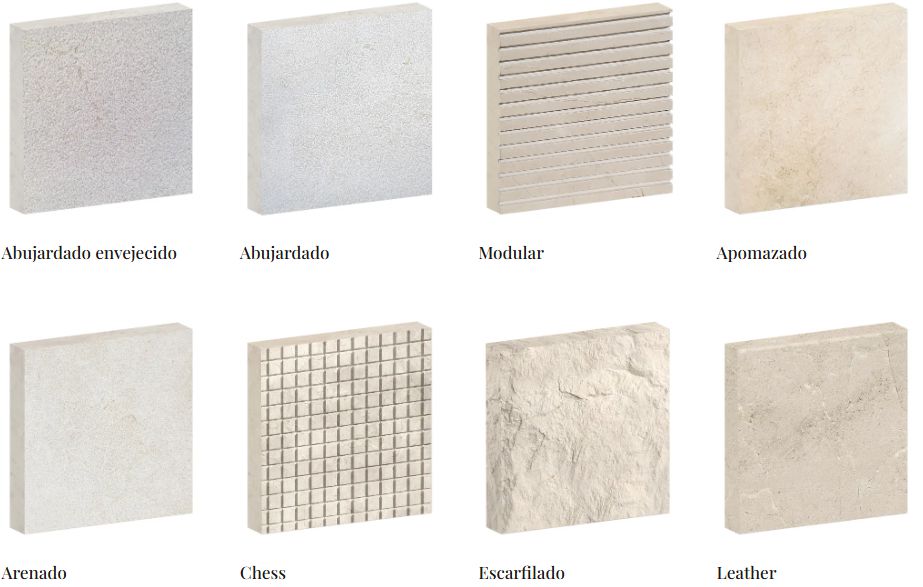
Polished, honed and other finishes
Polished finish. A glossy surface that brings out the colour and veining of the stone to the full. It is the most widely used finish indoors and the one that best represents the natural beauty of marble. It needs regular maintenance to keep its shine and is more prone to showing scratches with use.
Honed or matt finish. A surface with no shine and a more contemporary look. It hides marks and the wear of daily use better, which makes it especially suitable for high-traffic floors. It takes nothing away from the beauty of the marble — it simply shifts its visual register to something calmer and more modern.
Bush-hammered finish. A rough surface obtained by mechanical impact. It gives a rustic look and excellent slip resistance, and is the most widely used finish outdoors and in wet areas.
Flamed finish. Produced by exposure to heat, which makes the surface open up into small natural fractures. An irregular, natural look, widely used outdoors and in contemporary architecture projects seeking organic textures.
Brushed or tumbled finish. Gives a lightly textured surface with the look of hand-worked stone. Widely used in restoration projects and in interiors seeking a warm, artisan feel.
Buying marble slabs directly from the manufacturer
One of the most significant advantages of working with Pulycort is direct access to the material at source, with no middlemen pushing up the price or limiting the variety available.
Our catalogue includes more than 13 varieties of natural marble available in the main standard sizes and in large formats on request. We work with private customers who are renovating as well as architecture practices, builders and developers who need large volumes with specific delivery conditions.
You can browse the full catalogue, check availability by size and variety, and request samples with no obligation in our natural marble shop. If you have a project with specific requirements — a non-standard size, a special thickness or a large volume — write to us directly and we will prepare a tailored proposal.
Do you already know which size you need?
Visit our marble shop and find your variety in the size you need, or request a personalised quote for your project. We will get back to you as soon as possible.
📐 Need advice on sizes and dimensions?
Our technical team is available to answer any questions about sizes, thicknesses, finishes and transport logistics for your marble slab.